
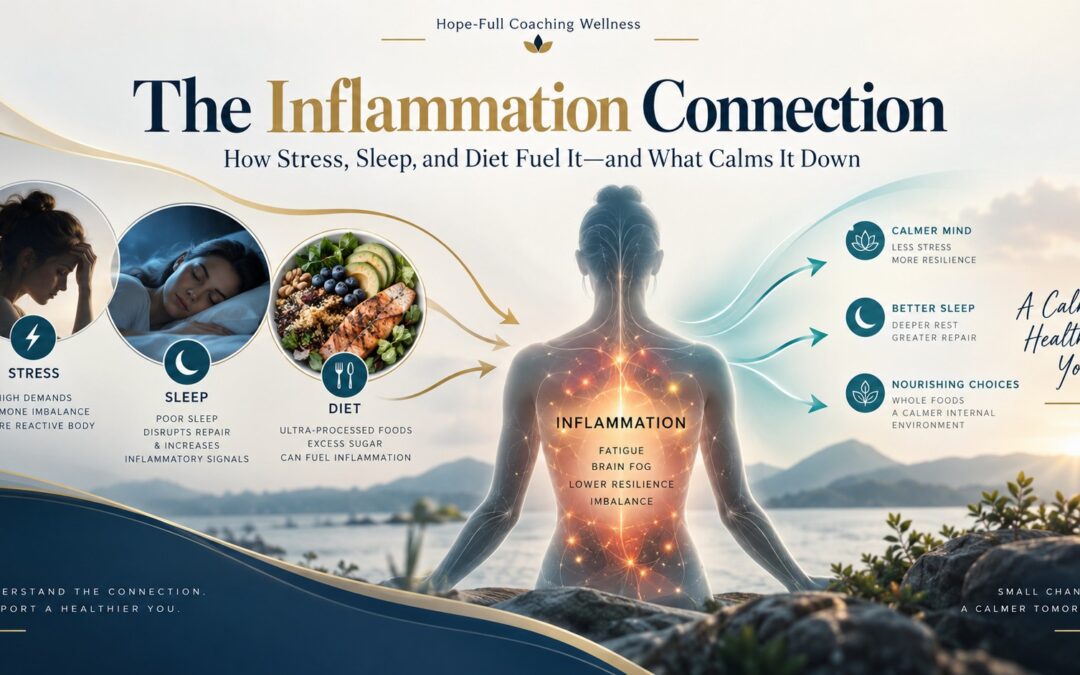
The Inflammation Connection
How Stress, Sleep, and Diet Fuel It
You've probably heard "inflammation" used as a kind of catch-all villain in wellness conversations—something to fight, reduce, or eliminate. But inflammation isn't actually the enemy. It's one of the most important things your body does. The real trouble starts when inflammation forgets how to turn off. The same protective response meant for a short-term threat gets triggered again and again—by ongoing stress, poor sleep, or a diet heavy in sugar and processed foods—until your body is running a low, constant simmer you can't always feel but that wears on you anyway. Understanding what's driving that simmer changes how you think about food, rest, and the daily choices that either feed it or help it settle.
What Inflammation Really Is (And Why It's Not the Enemy)
When you sprain an ankle or catch a cold, your immune system responds with acute inflammation—the redness, swelling, heat, and soreness that show up around an injury or infection. It's uncomfortable, but it's also your body's repair crew arriving on scene: blood flow increases, immune cells move in, damaged tissue gets cleared away, and healing begins. Once the threat is handled, a healthy immune system stands down and inflammation resolves.
Chronic, low-grade inflammation works differently. Instead of switching off once the job is done, the immune system stays partially activated—circulating low levels of inflammatory signals for months or even years. You typically can't feel it the way you feel a sprained ankle. It shows up quietly, in the background, and it's been linked to a long list of common health concerns when it persists over time.
What's Driving It: Stress, Sleep, and Diet
Your body's stress response is designed to be temporary. In a short-term stressful moment, cortisol actually helps rein inflammation in once the threat passes—it's part of the built-in "off switch." The problem is what happens when stress doesn't let up. Under chronic stress, immune cells can become less responsive to cortisol's anti-inflammatory signal, a pattern researchers call glucocorticoid resistance. One study comparing highly stressed caregivers of children with cancer to parents of healthy children found that the more distressed group had a blunted cortisol rhythm and immune cells that were measurably less able to respond to the hormone's anti-inflammatory signal (Miller, Cohen, & Ritchey, 2002, Health Psychology).
There's a second brake on inflammation, and it runs through your nervous system rather than your hormones. The vagus nerve—the main highway of your parasympathetic ("rest and digest") system—helps regulate immune activity through what researchers call the cholinergic anti-inflammatory pathway. Heart rate variability (HRV) describes variation in the time between heartbeats; some HRV measures are used as indices of cardiac vagal regulation, and lower HRV has been associated with higher circulating levels of inflammatory markers (Cooper et al., 2015, Brain, Behavior, and Immunity). In plain terms: patterns of lower vagally mediated HRV tend to track with higher inflammatory activity.
Sleep adds a third layer. In a recent meta-analysis pooling data from 35 studies, researchers found that a single rough night didn't move inflammatory markers much, but multiple nights of restricted sleep reliably raised both interleukin-6 and C-reactive protein—two of the most studied inflammation markers in the blood (Ballesio, Fiori, & Lombardo, 2026, Journal of Sleep Research).
Diet plays a major role, too—separate from stress and sleep, but no less significant. Diets high in ultra-processed foods and added sugar have been associated with markers of low-grade inflammation, although the evidence is stronger for overall dietary patterns than for sugar in isolation. In a large, nationally representative U.S. sample, adults who got the most calories from ultra-processed foods had significantly higher levels of high-sensitivity C-reactive protein (hs-CRP) than those who ate the least (Sajan et al., 2025, American Journal of Medicine). In a randomized crossover trial, healthy young men consumed low-to-moderate amounts of sugar-sweetened beverages for three weeks at a time. hs-CRP increased during the study periods, but it also rose during the low-fructose comparison condition, so the trial did not isolate sugar as the sole cause of the change (Aeberli et al., 2011, American Journal of Clinical Nutrition). None of this means an occasional treat is dangerous—it's the overall pattern, not any single food, that matters.
What Ongoing Stress and Inflammation Can Feel Like
None of these are dramatic on their own—but together, especially during high-stress stretches, they're worth reading as signals rather than inconveniences to push through:
- Fatigue that doesn't improve much with rest, even after a full night's sleep
- Aches, stiffness, or muscle tension with no clear injury behind it
- A foggy, hard-to-focus feeling that comes and goes
- Getting run down easily or catching every bug that goes around
- Skin flare-ups that seem to track your stress level more than anything you ate
- Digestive upset—bloating, an unsettled stomach—during especially demanding stretches
- Feeling "tired but wired" at night, like your body won't fully power down
These symptoms are not specific to inflammation and can have many causes, but persistent changes are worth paying attention to and discussing with a healthcare professional.
What You Can Do
The goal is not to chase inflammation itself, but to support the everyday systems that help your body regulate stress, recover, and return to balance.
- Protect consistent sleep, not just enough sleep. The research above suggests that repeated short nights can increase inflammatory activity, making a regular sleep routine an important part of recovery.
- Build in a daily nervous-system downshift. In a randomized trial, stressed, unemployed adults who completed a three-day mindfulness meditation program had lower circulating interleukin-6 four months later than a comparison group who did relaxation training without the mindfulness component (Creswell et al., 2016, Biological Psychiatry). You don't need a retreat—a short daily breathing or mindfulness practice is a realistic place to start.
- Rethink your plate, not just your plan. Dietary patterns heavy in ultra-processed foods and sugary drinks have been associated with higher inflammatory markers, while diets built around whole foods, vegetables, and fiber tend to run the other direction. Small, sustainable swaps—more whole foods, fewer sugary drinks and packaged snacks—add up more than any single overhaul.
- Move gently and consistently. Regular physical activity supports overall health, stress regulation, sleep, and metabolic health. It does not have to be intense to count.
- Notice "tired but wired" days and build in an actual pause. Not just pushing through until you collapse at the end of the day.
Putting It Into Practice: A Simple Daily Reset
You don't need to overhaul your life to start interrupting this cycle—you need one small, repeatable moment that tells your nervous system it's safe to stand down. Pick a consistent time each day (many people find right after lunch or right before dinner works well) and give yourself two to three minutes: slow your breathing down on purpose, engage one calming sense—a scent, a texture, a sound—and let your shoulders drop. It won't undo months of stress in one sitting, but done consistently, it builds the kind of consistent calming practice that can support nervous-system regulation over time.
Helpful Resources
- NCBI Bookshelf — StatPearls: Chronic Inflammation
- American Psychological Association — Stress Effects on the Body
- American Journal of Medicine — Ultra-Processed Foods and Increased High Sensitivity C-Reactive Protein
A Hope-Full Wellness Resource
Want a simple, repeatable way to build that daily pause into your day? Our Ocean Visualization – Meditation pairs a guided ocean visualization with a breathing exercise, affirmations, and ocean-wave audio—a multi-sensory reset designed to help you create a deliberate pause and support your body's shift out of high-stress mode.
Conclusion
Inflammation isn't something to fear—it's a sign your body is trying to protect you. The goal isn't to eliminate it; it's to help your body remember how to turn it back off. Sleep, a steadier diet, and small nervous-system downshifts won't fix everything overnight, but they speak directly to the biology behind chronic, low-grade inflammation. Small, repeatable choices—on your plate and off it—can help create the conditions your body needs for better regulation, recovery, and long-term wellness.
Sources
Miller, G. E., Cohen, S., & Ritchey, A. K. (2002). Chronic psychological stress and the regulation of pro-inflammatory cytokines: A glucocorticoid-resistance model. Health Psychology, 21(6), 531–541. https://doi.org/10.1037/0278-6133.21.6.531
Cooper, T. M., McKinley, P. S., Seeman, T. E., Choo, T.-H., Lee, S., & Sloan, R. P. (2015). Heart rate variability predicts levels of inflammatory markers: Evidence for the vagal anti-inflammatory pathway. Brain, Behavior, and Immunity, 49, 94–100. https://doi.org/10.1016/j.bbi.2014.12.017
Ballesio, A., Fiori, V., & Lombardo, C. (2026). Effects of experimental sleep deprivation on peripheral inflammation: An updated meta-analysis of human studies. Journal of Sleep Research, 35(1), e70099. https://doi.org/10.1111/jsr.70099
Sajan, K., Anthireddy, N., Matarazzo, A., Furtado, C., Hennekens, C. H., & Ferris, A. (2025). Ultra-processed foods and increased high sensitivity C-reactive protein. American Journal of Medicine, 138(12), 1742–1745. https://doi.org/10.1016/j.amjmed.2025.08.016
Aeberli, I., Gerber, P. A., Hochuli, M., Kohler, S., Haile, S. R., Gouni-Berthold, I., Berthold, H. K., Spinas, G. A., & Berneis, K. (2011). Low to moderate sugar-sweetened beverage consumption impairs glucose and lipid metabolism and promotes inflammation in healthy young men: A randomized controlled trial. American Journal of Clinical Nutrition, 94(2), 479–485. https://doi.org/10.3945/ajcn.111.013540
Creswell, J. D., Taren, A. A., Lindsay, E. K., Greco, C. M., Gianaros, P. J., Fairgrieve, A., Marsland, A. L., Brown, K. W., Way, B. M., Rosen, R. K., & Ferris, J. L. (2016). Alterations in resting-state functional connectivity link mindfulness meditation with reduced interleukin-6: A randomized controlled trial. Biological Psychiatry, 80(1), 53–61. https://doi.org/10.1016/j.biopsych.2016.01.008